
Displaced Communities
 BALTIC GERMANS (150,000
displaced by Hitler & Stalin; 95%+)
GERMANS OF YUGOSLAVIA
(over 200,000 expelled, imprisoned, displaced, emigrated; 98.5% total)
VOLGA GERMANS (over 400,000 expelled by Soviets to Kazakhstan)
DUTCH GERMANS (3,691 expelled,
15% of German population)
GERMANS OF ALSACE-LORRAINE
(100-200,000 expelled after WWI)
GERMANS OF CZECHOSLOVAKIA
(over 3,000,000 expelled
and displaced; 95% total)
GERMANS OF HUNGARY
(over 100,000 expelled, over
300,000 displaced; 88% of total)
GERMANS OF ROMANIA
(over 700,000 or 91.5% displaced by Hitler, USSR, & emigration)
US Internment of German-Americans, Japanese, & Italians
(10,906+ interned & blacklisted) NEW!
GERMANS OF POLAND, PRUSSIA
(over 5,000,000 expelled and displaced, nearly 100%) COMING SOON
GERMANS OF RUSSIA/UKRAINE
(nearly 1,000,000 to Germany and Kazakhstan) COMING SOON
Other Information
OUR YOUTUBE CHANNEL NEW!
(documentaries, interviews, speeches)
Follow us on FACEBOOK NEW!
(for updates, events, announcements)
"Reactions of the British Public and Press to the Expulsions" NEW!
"British Humanitarian Responses - or lack thereof - to German Refugees" NEW!
"British Political Responses to the German Refugee Crisis during Occupation" NEW!
From Poland, to Czechoslovakia, to Occupied Germany: My Flight from the Red Army to the West
(memoir about wartime flight & Jewish, Polish, & German daily life near Auschwitz) NEW!
Daily Diary of Forced Labor in the Mines of Soviet Ukraine NEW!
The problem of classifying German expellees as a 'genocide'
Why the German, Czech, and Polish governments reject expellee commemoration
Distorted historical memory and ethnic nationalism as a cause for forgetting expellees
Ethnic bias and nationalist revisionism among scholars as a cause for forgetting expellees
The History and Failure of Expellee Politics and Commemoration NEW!
Expellee scholarship on the occupations of Czechoslovakia and the Sudetenland, 1918-1945
Sexual Violence and Gender in Expellee Scholarship and Narratives
Suggested Resources & Organisations
In Memoriam: Your Expellee
Relatives & Survivors
Submit content and information
How to support German expellees / expellee political lobbies
Welcome/Willkommen 

NEWS! See
our latest book on ethnic cleansing against minorities
in Europe and Latin America,
Memoria del Olvido (Buenos
Aires: Grupo del Escritores, 2014).
NEWS! our newest scholarly publications: 1) Reactions of the British Public to the Expulsions; 2) British Humanitarian Responses to German Refugees; 3) British Political Responses to the German Refugee Crisis
RESEARCH CONTRIBUTIONS NEEDED: Germans of Kazakhstan; Roma (Gypsies);
Hungarians from Slovakia; Karelian Finns; South Tirol Germans; Poles from Ukraine; Turks from Bulgaria
please contact us for scholarly review
The Institute for Research of Expelled Germans (Institut für Vertriebenenforschung) is an academic research organisation documenting the largely unknown story of more than 10,000,000 ethnic German civilians who were subjected to deportation, compulsory labour, and in many cases starvation and ethnic violence *AFTER* World War II.
This process had varying support and involvement by the governments of the Soviet Union, the United States, the United Kingdom, Czechoslovakia, Poland, Hungary, the Netherlands, Romania, and Yugoslavia.
We are a non-political research institute. In no way do we intend to sanitise German atrocities, to misrepresent Germany as a "victim", or undermine the genocides against other ethnic groups by the Germans or Soviets. We strongly reject any revisionist, Antisemitic, or pro-Nazi tendencies. We have no relationship with political lobbies whatsoever. We actively cooperate with research groups on the forced migration of Roma (Gypsies), Finns, Jews, Poles, Ukrainians, and others to better understand the largest period of forced migration in modern history.
The displacement of ethnic German civilians mostly took place AFTER World War II. By 1945, the United States, the United Kingdom, and the Soviet Union had finalised the Potsdam Conference, in which the borders of post-war Europe were redrawn. Germany ceded nearly 30% of its official territory, leaving huge ethnic German minourities as new constituents of Czechoslovakia and Poland. The Soviet Union and the newly-independent Eastern European Communist states included large German populations that had lived there for centuries (and in the Baltic and Transylvania for over 800 years).
Considering these civilian populations 'dangerous' regardless of their personal ideologies or Nazi involvement, the governments of Poland, Czechoslovakia, Yugoslavia, and the USSR forced the near entirety of the German civilian populations to be force marched into labour camps or to a Germany that their ancestors had often not seen for centuries.
The 'legal' expulsions of the Potsdam Conference accompanied the deaths of an uncertain number of civilians during the extra-judicial 'wild expulsions' of 1944-1945. At the same time, Soviet Order #7161 planned to deport all physically-able men and women from German minourities to the Soviet Union for forced labour. Almost all of the 1,084,828 German settlers in the Soviet Union alone were shipped on trains to Siberia and Kazakhstan. Thousands starved to death in transit. In Czechoslovakia and Poland, many were suffered legal discrimination by being forced to wear white armbands to expedite their exclusion.
The Allied and Soviet deportation programmes supplemented the previous displacement of nearly a half-million ethnic Germans from Eastern Europe under diplomatic negotiation between Adolf Hitler and Soviet leader Joseph Stalin in the Non-Aggression Pact of 1939. At the same time, 10,906 German-Americans (both citizens and resident aliens) were shipped alongside Japanese- and Italian-Americans to US internment camps.
In total, at least 473,013 expellees may have died during the expulsions due to hypothermia, starvation, and to a lesser extent direct violence [1]. The Red Cross and the West German government cited a less verifiable 2,200,000 deaths [2].
While such traumas are rightfully overshadowed in public memory by tragedies like the Holocaust, the scale of human suffering here remains to be fully appreciated.
The experience of millions of ethnic German families from 1945-50 was an unfortunate feature of much larger trend of forced homogenization, during which most nations in Eastern Europe remapped their borders along exclusive ethnic lines. Regardless of their national loyalty, minourities in general had no place in the new post-war states of 1945.
Although this was the largest mass movement in modern history, this same trend led to the expulsion of millions of ethnic Poles, Ukrainians, Chechens, Ingush, Kalmyks, Koreans, Finns, Tatars, and Hungarians during the same period by their host nations. The story of the expelled Germans thus reflects the suffering of a far broader refugee and minourity experience.
Especially as the European Union struggles to address the current refugee debate following the Syrian Civil War and other conflict zones, it is as crucial as ever to develop a richer understanding of -- and more importantly to raise awareness of -- previous episodes of mass human displacement and struggles toward integration in Europe.
Expelled
and Displaced German Civilian Population Statistics
(see our scholarly articles at left
for cross-referenced sources and statistics)
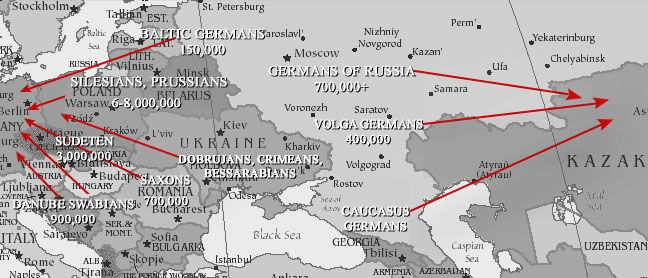
Baltic
Germans (from 1939-45)- 150,000 displaced by Hitler and
Stalin's negotiations and Soviet expulsions
Germans of the Soviet Union
(Caucasus, Black Sea, Bessarabian, etc.)- nearly all of 1,084,828
(nearly 100% expelled), as many as 300,000 may have died (or
30% total)
Volga
Germans (included within USSR stats)- over 400,000 (nearly
100%)
Dutch Germans- 3,691, or 15%
of the total German population
Prussian, Silesian, Pomeranian
Germans expelled by USSR and Poland- 5-8,000,000 (almost
100%)
Alsace-Lorraine Germans (after
World War I)- over 100,000 expelled
Sudeten and Carpathian Germans
of former Czechoslovakia- over 3,000,000 displaced and expelled
(95% total)
Germans of Hungary- over
100,000 expelled, 300,000 displaced (88% total)
Transylvania Saxons &
Banat Swabians of Romania- 700,000 displaced by Hitler, USSR, emigration (91.5%)
Danube Swabians of Yugoslavia-
over 200,000 gaoled, executed, expelled, displaced, or fled
(98.5%)
______________________________________
TOTAL= approximately 10-13,000,000 civilians expelled or displaced, at least 473,013 dead.
[1] While the West German government and the Red Cross maintained an unverified and controversial number of over 2 million for many decades, and expellee groups often exaggerated to as many as 3 or 4 million as part of genocide, most scholarly estimates today cite a minimum of 400,000 deaths. Hahn and Hahnova cite 473,013, Ingo Haar "“no more than 0.5 to 0.6 million,” and Overmanns roughly 600,000. See Ingo Haar, “Die deutschen ’Vertreibungsverluste’ – Forschungsstand, Kontexte, und Probleme,“ in Mackensen, Rainer. Ursprünge, Arten und Folgen des Konstrukts "Bevölkerung" vor, im und nach dem "dritten Reich": zur Geschichte der Deutschen Bevölkerungswissenschaft(1. Aufl. Wiesbaden: Verlag für Sozialwissenschaften, 2009), Hahnová, Eva, and Hans-Henning Hahn. Die Vertreibung im Deutschen Erinnern: Legenden, Mythos, Geschichte (Paderborn: Schöningh, 2010), and Overmans, Rüdiger. "Personelle Verluste der deutschen Bevölkerung durch Flucht und Vertreibung," Dzieje Najnowsze Rocznik (XXI-1994).
[2] Michael Burleigh, The Third Reich: A New History (Hill and Wang, 2001), 799.